
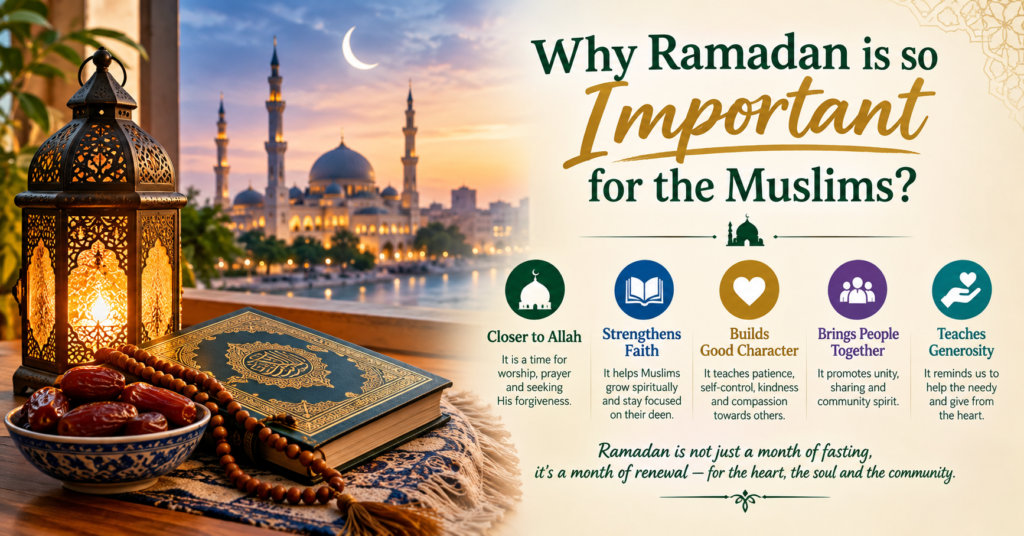
Every year, when the crescent moon rises to mark the beginning of Ramadan, something inside every believer shifts. I still remember the first time I truly understood what this month meant beyond just skipping meals it was the quiet hour before dawn, sharing suhoor with family, that made me realize why Ramzan holds such a sacred place in the Islamic calendar. This isn’t just another entry on the Islamic calendar; it’s arguably the most special and great month Muslims look forward to all year. From dawn to dusk, Muslims across the world observe fasting, abstaining from food and water, but the real purpose runs far deeper than the physical act of going without. Fasting teaches patience, gratitude, and self-control, which is exactly why so many people describe it as a genuinely beautiful time.
There are countless reasons why this month matters so much, but for me, the most powerful one is the chance to strengthen my bond with Allah (SWT). When you fast from dusk till dawn, you’re not just training your body you’re training your soul to avoid sins, since sins tend to weigh heavier when the heart is this focused. I’ve read through dozens of write-ups and even written a blog post reflecting on this myself, and every time I come back to the same conclusion: Ramadan gives Muslims a rare, quiet window to reset spiritually. It’s this blend of discipline, devotion, and community that makes the month so important not just religiously, but personally, for everyone who observes it.
Reasons of why Ramadan is very important for the Muslims
There isn’t just one reason Muslims treasure this month it’s a mix of duty, devotion, and history that comes together beautifully.
Fulfilling the pillar of Islam in Ramadan
Ask any of the Muslims you know why they fast so seriously during Ramzan, and most will tell you it isn’t just a personal choice it’s an obligation, since fasting sits among the five pillars of Islam. I remember my grandfather telling me that once you understand this month isn’t optional, you start treating it differently altogether. Ramadan becomes less about hunger and more about intention, because Muslims keep the fast purely for the sake of Allah (SWT), and SWT alone, with no audience and no reward expected from anyone else. That’s precisely what makes this month so special and so important — it’s a duty stripped down to its purest, most private form, where only you and your Creator know whether you truly fulfil it.
Quran was first revealed in Ramzan
What really gives this month its soul, though, is the story behind it. The Quran, the last book of Allah, was first revealed during this exact month of Ramzan, sent down to Hazrat Muhammad (SAWW), the last prophet chosen to carry Allah’s final message to mankind. Every time I recite even a few verses during Ramadan, I try to picture that moment of revelation how something so massive for humanity began in a quiet cave. That’s why Muslims hold this month so close to their hearts; it isn’t only about restraint, it’s the important anniversary of when guidance itself entered the world.
Great rewards in Ramadan:
Out of everything I’ve come to love about this month, the sheer scale of reward waiting for Muslims during Ramzan is what keeps me counting down the days each year. This isn’t just a chance to do a little extra it’s a genuine opportunity to earn rewards far beyond what any ordinary action would bring the rest of the year. Every good deeds you manage, big or small, gets multiplied, and that’s exactly why Ramadan feels so dear to the hearts of believers. Of course, none of it counts unless it’s done purely for the sake of Allah (SWT) alone, with no other motive tangled in. I still remember a teacher once breaking down a hadith narrated by Abu Hurairah (RA), where Hazrat Muhammad (SAWW) explained that a son of Adam‘s good action is worth ten times its value, sometimes climbing as high as 700 times.
But here’s the part that always gives me chills: Allah made one exception to that rule. Fasting, He says, belongs to Him alone, and He rewards it Himself, without limit. Think about that for a second a person gives up food and gives up desire purely for His sake, and in return, Allah takes personal charge of that reward. That single detail alone tells you why this month carries such weight; it’s not just about discipline, it’s about a direct, personal exchange between the servant and the Creator.
Mention of Ramadan in Quran and Hadith:
Whenever I want to explain to someone why Ramadan matters so deeply, I don’t start with my own words I start with the sacred texts themselves, because both the Quran and Hadith speak about it directly, and that’s rare for any single month to receive. The month of Ramadhan is actually named in the Qur’an itself, in Quran 2:185, where Allah says it’s the month in which the Quran was revealed as guidance for people, carrying clear proofs of direction and a criterion to separate right from wrong. That same verse tells Muslims that once they sight the new moon once the sights confirm Ramadan has begun they must fast, though anyone who is ill or away on a journey can make up an equal number of other days later. What strikes me every time I read it is how Allah doesn’t want hardship for us; He wants ease, and simply asks that we complete the period, glorify Him for being guided, and stay grateful.
Then there’s the Hadith, narrated by Abu Hurairah (RA), where Prophet Muhammad (SAWW) described something almost cinematic that when Ramadan arrives, the gates of Paradise are opened, the gates of Hellfire are closed, and the devils are chained (Al-Bukhari and Muslim). I remember hearing this as a kid and thinking it sounded like a fairy tale, but as I got older, I realized it’s exactly why this month, observed by Muslims around the world, feels so spiritually charged and so important. It’s no coincidence that people pour themselves into ibadat, zikr, and other good deeds during these weeks, all for the sake of Allah (SWT), hoping to please Allah, earn rewards, seek forgiveness, and simply please Him.