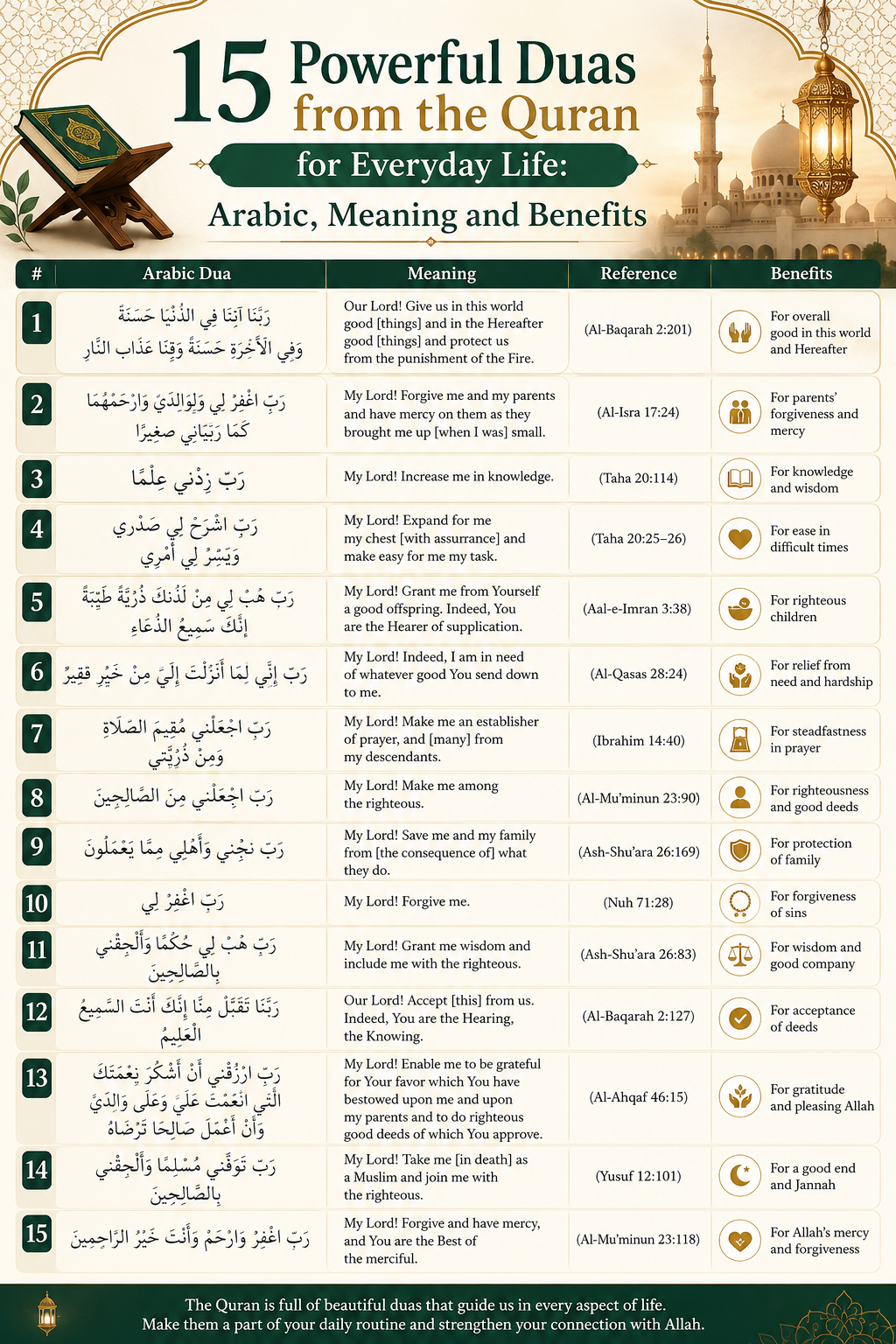
Dua is one of the most beautiful ways for Muslims to communicate with Allah. It allows believers to ask for guidance, forgiveness, protection, patience, and blessings in every situation. Throughout the Holy Quran, Allah has taught us many meaningful supplications that can help us strengthen our faith and improve our relationship with Him.
These Quranic duas were recited by Prophets and righteous believers. They remind us that Allah is always the One to whom we should turn during happiness, sadness, difficulties, and uncertainty.
In this article, we will explore 15 powerful duas from the Quran, along with their Arabic text, English transliteration, meanings, and references.
1. Dua for Guidance and Mercy
Arabic:
رَبَّنَا لَا تُزِغْ قُلُوبَنَا بَعْدَ إِذْ هَدَيْتَنَا وَهَبْ لَنَا مِن لَّدُنكَ رَحْمَةً ۚ إِنَّكَ أَنتَ الْوَهَّابُ
Transliteration: Rabbana la tuzigh quloobana ba’da idh hadaytana wa hab lana min ladunka rahmah, innaka antal-Wahhab.
Meaning: Our Lord, let not our hearts deviate after You have guided us and grant us from Yourself mercy. Indeed, You are the Bestower.
Reference: Surah Aal-e-Imran (3:8)
This beautiful dua asks Allah to keep our hearts firm upon guidance and bless us with His mercy.
2. Dua for Forgiveness and Mercy
Arabic:
رَبَّنَا ظَلَمْنَا أَنفُسَنَا وَإِن لَّمْ تَغْفِرْ لَنَا وَتَرْحَمْنَا لَنَكُونَنَّ مِنَ الْخَاسِرِينَ
Transliteration: Rabbana zalamna anfusana wa illam taghfir lana wa tarhamna lanakoonanna minal khasireen.
Meaning: Our Lord, we have wronged ourselves, and if You do not forgive us and have mercy upon us, we will surely be among the losers.
Reference: Surah Al-A’raf (7:23)
This was the supplication of Adam and Hawwa (peace be upon them). It teaches us to acknowledge our mistakes and sincerely seek Allah’s forgiveness.
3. Dua for Knowledge
Arabic:
رَّبِّ زِدْنِي عِلْمًا
Transliteration: Rabbi zidni ilma.
Meaning: My Lord, increase me in knowledge.
Reference: Surah Ta-Ha (20:114)
This short but meaningful dua is especially valuable for students, teachers, and anyone seeking beneficial knowledge.
4. Dua for Patience and Strength
Arabic:
رَبَّنَا أَفْرِغْ عَلَيْنَا صَبْرًا وَثَبِّتْ أَقْدَامَنَا
Transliteration: Rabbana afrigh alayna sabran wa thabbit aqdamana.
Meaning: Our Lord, pour upon us patience and make our feet firm.
Reference: Surah Al-Baqarah (2:250)
This dua teaches believers to ask Allah for patience and strength when facing difficult situations.
5. Dua for Parents
Arabic:
رَّبِّ ارْحَمْهُمَا كَمَا رَبَّيَانِي صَغِيرًا
Transliteration: Rabbir hamhuma kama rabbayani sagheera.
Meaning: My Lord, have mercy upon them as they brought me up when I was small.
Reference: Surah Al-Isra (17:24)
This is a beautiful Quranic supplication for parents. Muslims can recite it while asking Allah to bless their mother and father with mercy.
6. Dua for Goodness in This World and the Hereafter
Arabic:
رَبَّنَا آتِنَا فِي الدُّنْيَا حَسَنَةً وَفِي الْآخِرَةِ حَسَنَةً وَقِنَا عَذَابَ النَّارِ
Transliteration: Rabbana atina fid-dunya hasanatan wa fil-akhirati hasanatan wa qina adhaban-nar.
Meaning: Our Lord, give us good in this world and good in the Hereafter and protect us from the punishment of the Fire.
Reference: Surah Al-Baqarah (2:201)
This comprehensive dua asks Allah for goodness in both worlds and protection from Hellfire.
7. Dua for Making Difficult Tasks Easy
Arabic:
رَبِّ اشْرَحْ لِي صَدْرِي وَيَسِّرْ لِي أَمْرِي
Transliteration: Rabbishrah li sadri, wa yassir li amri.
Meaning: My Lord, expand my chest and make my task easy for me.
Reference: Surah Ta-Ha (20:25–26)
Prophet Musa (peace be upon him) made this dua when preparing for an important mission. It reminds us to seek Allah’s help before challenging tasks.
8. Dua for Protection from Hellfire
Arabic:
رَبَّنَا اصْرِفْ عَنَّا عَذَابَ جَهَنَّمَ إِنَّ عَذَابَهَا كَانَ غَرَامًا
Transliteration: Rabbana isrif anna adhaba jahannama inna adhabaها kana gharama.
Meaning: Our Lord, avert from us the punishment of Hell. Indeed, its punishment is ever adhering.
Reference: Surah Al-Furqan (25:65)
This supplication teaches Muslims to seek Allah’s protection from the punishment of the Hereafter.
9. Dua for a Righteous Family
Arabic:
رَبَّنَا هَبْ لَنَا مِنْ أَزْوَاجِنَا وَذُرِّيَّاتِنَا قُرَّةَ أَعْيُنٍ وَاجْعَلْنَا لِلْمُتَّقِينَ إِمَامًا
Transliteration: Rabbana hab lana min azwajina wa dhurriyyatina qurrata a’yunin waj’alna lil-muttaqeena imama.
Meaning: Our Lord, grant us from among our spouses and offspring comfort to our eyes and make us an example for the righteous.
Reference: Surah Al-Furqan (25:74)
This dua asks Allah for a loving family and righteous children who follow His guidance.
10. Dua for Repentance
Arabic:
رَبِّ إِنِّي ظَلَمْتُ نَفْسِي فَاغْفِرْ لِي
Transliteration: Rabbi inni zalamtu nafsi faghfir li.
Meaning: My Lord, indeed I have wronged myself, so forgive me.
Reference: Surah Al-Qasas (28:16)
Prophet Musa (peace be upon him) made this sincere supplication after recognizing his mistake. It reminds us that we should turn to Allah whenever we fall short.
11. Dua for Gratitude
Arabic:
رَبِّ أَوْزِعْنِي أَنْ أَشْكُرَ نِعْمَتَكَ الَّتِي أَنْعَمْتَ عَلَيَّ وَعَلَىٰ وَالِدَيَّ
Transliteration: Rabbi awzi’ni an ashkura ni’mataka allati an’amta alayya wa ala walidayya.
Meaning: My Lord, enable me to be grateful for Your favor which You have bestowed upon me and upon my parents.
Reference: Surah An-Naml (27:19)
This dua teaches the importance of thanking Allah for His countless blessings.
12. Dua for Protection from Anxiety and Wrongdoing
Arabic:
رَبَّنَا لَا تَجْعَلْنَا فِتْنَةً لِّلْقَوْمِ الظَّالِمِينَ
Transliteration: Rabbana la taj’alna fitnatan lil-qawmiz-zalimeen.
Meaning: Our Lord, do not make us a trial for the wrongdoing people.
Reference: Surah Yunus (10:85)
This supplication was made by Musa’s people. It asks Allah for protection during difficult circumstances.
13. Dua for a Good Ending
Arabic:
تَوَفَّنِي مُسْلِمًا وَأَلْحِقْنِي بِالصَّالِحِينَ
Transliteration: Tawaffani Musliman wa alhiqni bis-saliheen.
Meaning: Cause me to die as a Muslim and join me with the righteous.
Reference: Surah Yusuf (12:101)
This is part of the supplication of Prophet Yusuf (peace be upon him). It expresses the desire to remain faithful and be joined with the righteous.
14. Dua for Forgiveness for Believers
Arabic:
رَبَّنَا اغْفِرْ لَنَا وَلِإِخْوَانِنَا الَّذِينَ سَبَقُونَا بِالْإِيمَانِ
Transliteration: Rabbana ighfir lana wa li-ikhwanina alladhina sabaquna bil-iman.
Meaning: Our Lord, forgive us and our brothers who preceded us in faith.
Reference: Surah Al-Hashr (59:10)
This dua encourages Muslims to pray for themselves and other believers, including those who passed away before them.
15. Dua for Help in Worship
Arabic:
رَبِّ اجْعَلْنِي مُقِيمَ الصَّلَاةِ وَمِن ذُرِّيَّتِي رَبَّنَا وَتَقَبَّلْ دُعَاءِ
Transliteration: Rabbij’alni muqimas-salati wa min dhurriyyati rabbana wa taqabbal du’a.
Meaning: My Lord, make me an establisher of prayer, and from my descendants. Our Lord, accept my supplication.
Reference: Surah Ibrahim (14:40)
This dua reminds us to ask Allah to help us and our children remain regular in Salah.
How to Make Dua According to Islamic Teachings
Making dua is a beautiful act of worship. Muslims can make supplications at any time and ask Allah for their needs.
Here are some helpful practices:
- Begin by praising Allah.
- Send blessings upon Prophet Muhammad ﷺ.
- Ask Allah sincerely and with humility.
- Have hope in Allah’s mercy.
- Ask for forgiveness for your mistakes.
- Make dua for your family and other Muslims.
- Continue supplicating with patience.
There is no need to limit your personal duas to a particular language. You can ask Allah in your own language as well.
Final Thoughts
The Quran contains many beautiful duas that guide Muslims through different situations in life. Whether you need forgiveness, knowledge, patience, protection, or blessings for your family, these supplications remind you to turn toward Allah.
Try learning one dua at a time, understand its meaning, and include it in your daily worship. Most importantly, make dua with sincerity and trust in Allah.
May Allah accept our supplications, forgive our shortcomings, guide our families, and grant us goodness in this world and the Hereafter. Ameen.